MLK Quote

MLK Quote

Nature's Inspiration Movie

http://www.flickspire.com/m/HealthierL433/NaturesInspiration -- Nature's Inspiration Movie: The photographs in this short video are from award-winning photographer, Ken Jenkins, and they are breathtaking. However, this video is much more than beautiful photographs! Peggy Anderson has compiled beautiful quotations from the likes of Emerson, Thoreau, and many others that truly capture the beauty of nature and solitude. Absolute must watch for nature lovers.

Monday, August 12, 2013

Mill Creek Apiaries and Liberty Farm

What a wonderful three hours of time we had yesterday (Sunday, August 11). Yesterday was the one year anniversary of my mother's passing away and I was mentally down. But all my woes and depression went away as soon as I set foot on the farm for the field-day celebration.

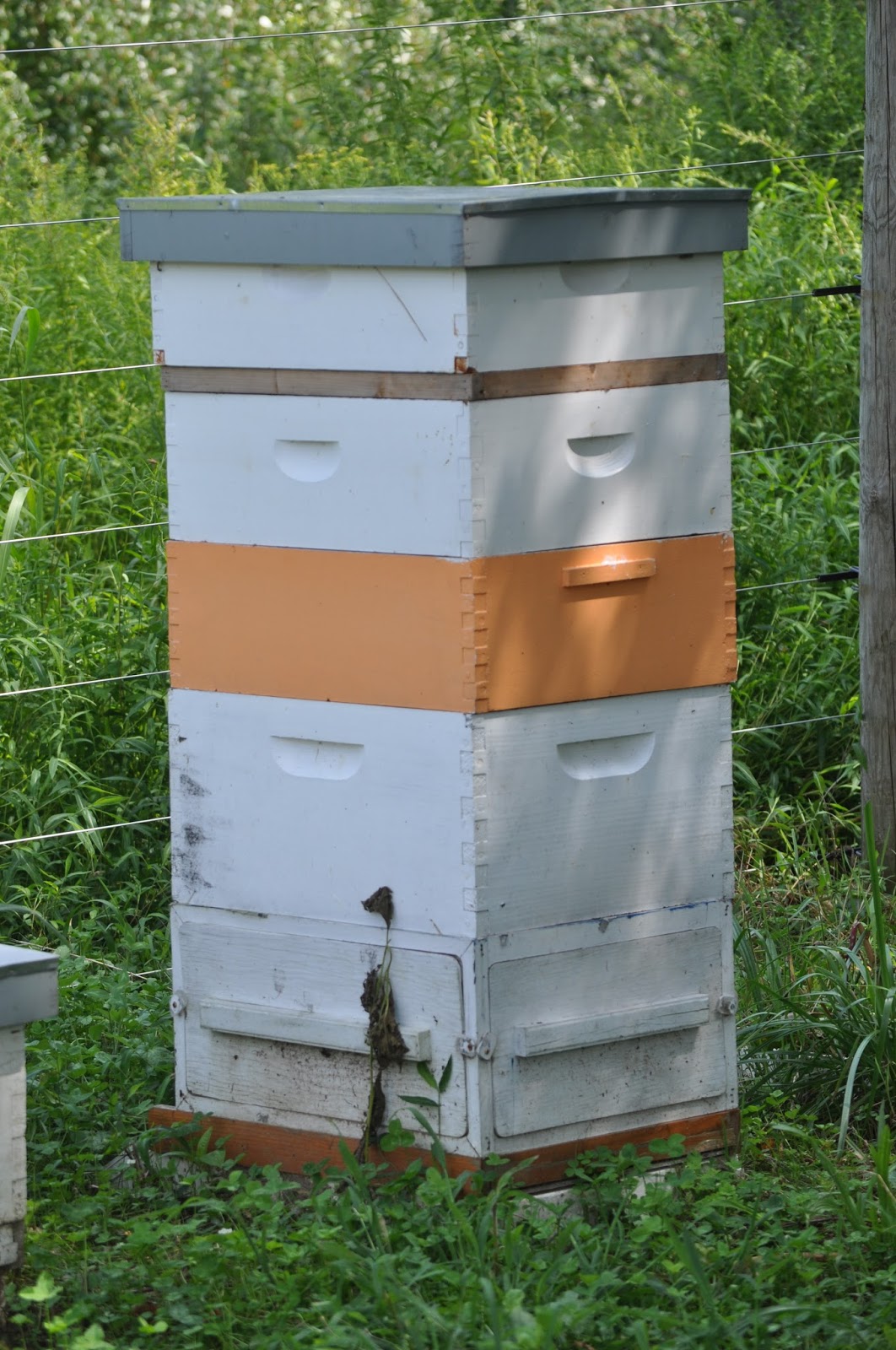
The field day was organized by David Kunz of Mill Creek Apiaries , an extremely-knowledgeable and honest bee-keeper. His farm is a family-owned, small-scale bee farm in NJ. They use essential oils and natural methods to take care of their hives. They have an adopt-a-hive program, and through it, we have adopted a bee-hive. No, they will not be located in our garden, though they do allow such opportunities. It is just a program for those who want to support local sustainability and are concerned about the pollinators.

The field-day takes place on various farms. So, yesterday it took place on Liberty farm, owned by Raj Sinha and his wife. The farm was an old, abandoned farm dating back from 1790 and beyond (the exact date of the beginning of the farm is not known, but municipal record shows that tax was paid for the farm house in 1790). It still has those old buildings and barns with beautiful round roofs. It is about 40 acres.

It was a beautiful farm. A small farm-stand sits on the left side as you enter the farm. It has fresh produce that were picked on the morning only. It's based on honor system; no one is there to monitor you; you take the vegetables/fruits and then put the money in a box. The farm has some chickens and ducks, and some of the bee-hives of David. Only small portion of the farm is cultivated for corn and vegetables. Most of the other portion is restored to natural habitat. The owners are working with USDA to create vernal pool, restore the creeks and water bodies of Little Flatbrook that border the farm; Little Flatbrook is considered one of the top native trout streams in NJ. All the invasive species are being cleared away, and in its place the native trees are planted.

Native flowers and wild flowers are everywhere in the farm. Many orchards, fruit and nut trees can be found in the farm. We saw so many butterflies of humongous size -- bright reddish-orange, yellow, black with blue marks and the common cabbage butterflies. Frogs, dragon-flies, bees and other flying-and-buzzing insects were everywhere. Native grasses ran wild there. Weeds and wild native plants were everywhere and there lied the beauty of that farm.

Raj Sinha and his wife does not use any sort of chemical to do commercial farming. They do not use any kind of GMO seeds. They harvest most of their vegetables, to be sold commercially in markets and farm-stands through-out NJ, by hand!!!!!!!!!!!!(I can't put enough exclamation as they have large tracts of lands to harvest). The farm actually didn't look like farm but rather a natural wild-life habitat with weeds running wild. I do small-scale farming for our own consumption in our backyard, and I always thought that weeds were bad for growing vegetables. That's why I would painstakingly try to rip out, by hand, one weed at a time. But after seeing the farm yesterday and tasting the vegetables, I don't think I will ever be so adamant about weeds taking up my vegetable bed. It was uplifting and joyous to see farming being done in such a natural and environmental-friendly way.

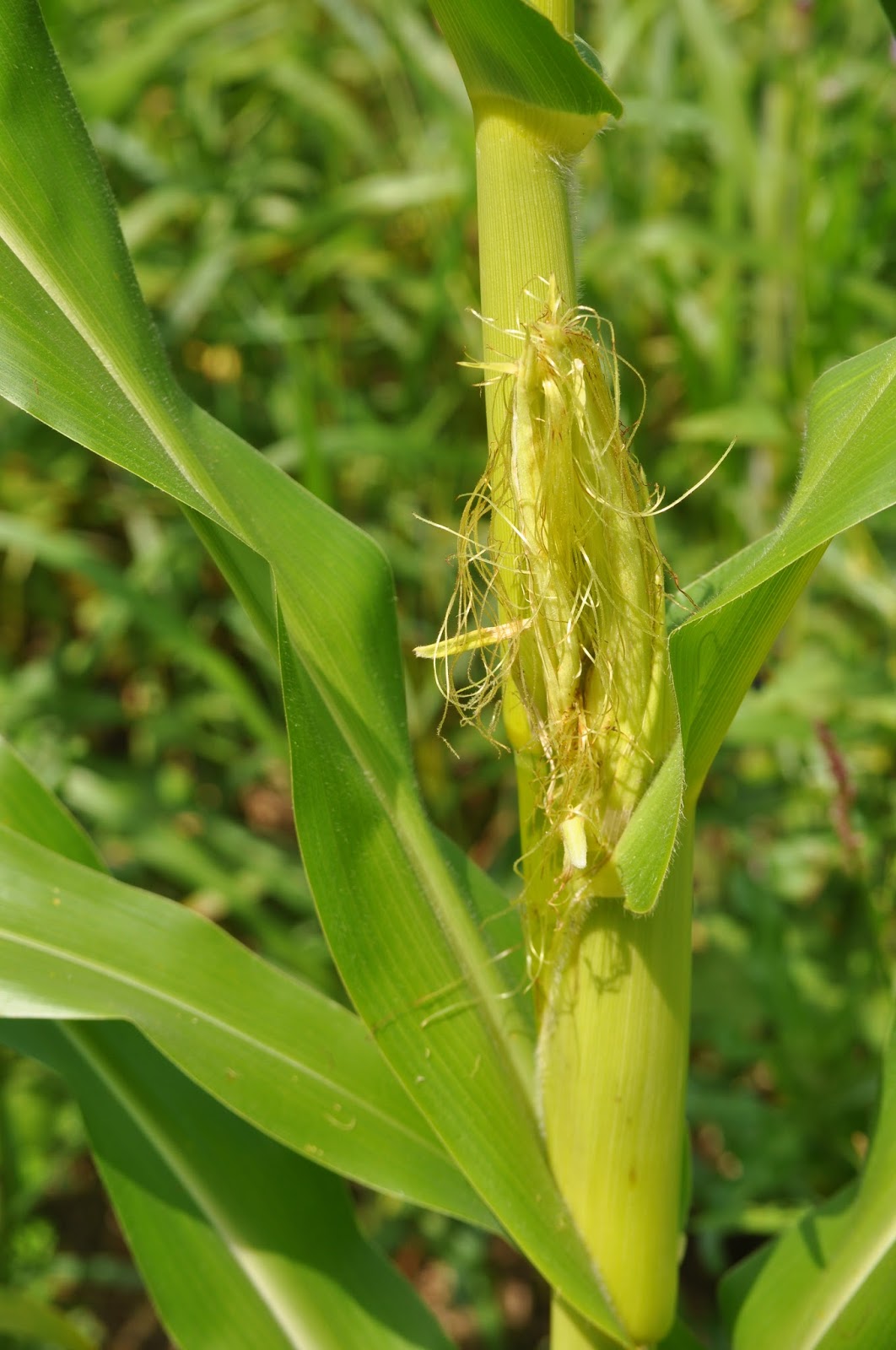
The farm grows a corn, called Mirai or something, that is simply out of this world. We never knew that corn can be so sweet. I am not exaggerating but the corns were tender and sweet-as honey. Every one in the group were astounded to taste it and we all brought pick-your-own-corn. We cannot seem to have enough of it -- we ate some in the farm; then we ate some while driving back to home; we also ate some in the breakfast. The corn is so tender that one has to pick it by hand, else it will get bruised; it cannot also be cooked for long; it's best eaten raw or just heated for a minute or so in the microwave. None of us knew that a whole corn can be eaten raw like that and taste sweeter than honey!! Peaches were also delicious -- soft and full of juice. Honestly, nothing beats the taste of freshly picked fruits and vegetables, no matter how much organic you buy from market. We also buy organic but organic tomatoes and freshly-picked tomatoes -- they are further apart than north and south pole are. The bears and deers also know that. They destroy huge portion of the farm produce.

Well, I have been constantly talking about the farm though the focus of the day was bee and bee-hives. Well, what more can I say other than that I was astounded by the knowledge of the bee-keeper and the calmness of bees. I always thought that bees were ferocious creatures. That's the idea I and most people around me were brought up with. That's why I always saw bees were being killed if any were found. Now that I do gardening, I have to do a lot of work among them but still I respect them and keep a respectable distance away from them. Yesterday, David was taking the hives away from the box, brushing the bees away and doing all sorts of things, and we -- children and old -- were standing around unprotected (I put on a half-bee protection suit that David gave; I always wanted to don those and didn't give away the opportunity when I got one yesterday :-D), and none of the bees did anything to us. They were such gentle!!

David demonstrated a lots of things to us -- how queen bees are captured, how they are put in a hive in a protective cage, at first, so that the worker-bee does not attack; he showed us the various bees in a colony -- drone, queen and the workers and the living quarters of each of them. The living quarters of drones look very different from those of queens. He showed us the hives where baby-bees were being produced. He made us taste fresh honey from the hive. He gave us live demonstrations, as much as possible, and told us about everything -- how queens would be put in a hive, how she will produce the babies, how worker bees will take care of the queen and the babies, how everything is sequenced so that the bees keep on working and producing honey and how cares have to be taken so that the bees do not form swarm and fly away -- just too much information. I should have taken a pen and a notebook to write everything down. Do you know that bee-pollen and bee-honey are too different things?

Bee pollen is just the pollen of the flowers and is full of protein. Bee honey is the nectar of the flower that the bee take, then regurgitates, fan out the excess moisture and produce that thick honey. Huh! I am trying to imagine all the bees moving their wings and fanning out the water from the nectar -- isn't this amazing? They also produce another thing which completely glues the hive-boxes together -- it's a sticky, brownish material, and David had to really pry open those boxes.

Though David has not yet suffered from Colony Collapse Disorder, but he was agreeing with the fact that too much misuse of chemicals is one of the reasons for CCD. My respect for bee-keepers and organic farmers gained more momentum yesterday. It was a sheer delight to see their work places and their work, listen to their philosophies and watch their practices. Thank You to both Mr. David Kunz and Mr. Raj Sinha for not only making a field-day wonderful but also for working hard to sustain all of us.

Monday, August 5, 2013

Wild Wild West -- Introduction

I have been away from the blog world because I was away for a conference and then a vacation. What a vacation it was: we drove 4138 miles (about 6660 km) through five states (California, Nevada, Arizona, Utah and Colorado), five major cities (Palo Alto, San Francisco, Reno, Las Vegas and Flagstaff) and two time-zones (Pacific and Mountain Times). We visited twelve national parks and monuments (Yosemite, Hoover Dam, Grand Canyon, Zion, Bryce Canyon, Death Valley, Petrified Forest, Rainbow and Colored Desert, Meteor Crater, Canyonland, Arches National, Great Basin, Dinosaur Monument and Lassen Volcanic). We visited Yosemite in January of 2010 and I liked Yosemite much better that time. I did not like Yosemite this time with all the crowds and tourists. The whole beauty of nature and silence was gone with all those people, cars, bikes and buses.


While visiting those national parks and monuments, we drove through many treacherous roads, scenic by-ways, snaky mountain roads where one small mistakes will plunge the car into abysmal, and twelve national forests (Ashley, Dixie, Fishlake, Humboldt-Toiyabe, Inyo, Kaibab, Lassen, Plumas, Sierra, Stanislaus, Tahoe, Uncompahgre). We drove through what is known as the Loneliest Road in America :-) though I have to say that almost all the roads out there were lonely. We would hardly see any car and there were no cell phone reception. If anything happened to our cars, we would have been stranded either in the middle of a desert or forests with rattle snakes, wild goats, deer, wild horses, bear and mountain lions as our companies. We experienced temperature ranging from 50 degree Fahrenheit to 124 degree Fahrenheit (10 degree to 52 degree Centigrade). We climbed up to about 11,000 feet above sea-level (in Great Basin National Park) and climbed down to about 500 ft below sea-level (in Death Valley). People driving through Death Valley should take extra precautions as the car climbs down from about 7000 feet above sea-level to 500 feet below sea-level in a matter of about 10 to 15 minutes. With such drastic change in altitude and air-pressure in such a short time, the sinus cavities are really affected and gets clogged.

We saw numerous geologic eras, strata and formations, lakes, creeks, mountains, canyons, trails, passes, deserts, meteor craters, volcanoes, glaciers, caves, dams (e.g. Hoover Dam), petroglyphs, wildlife and vegetation, wildlife refuges, tribal territories, cities, towns and villages. The sleepy villages had all the charm of old-days with country or general stores and no chain-stores. Out there, they called a small collection of about hundred people a city :-) -- well, one can't really blame them! If for thousands of miles there are no human-dwelling and if suddenly there is a place with hundred people, like an oasis in desert, then it has to be called a city! Travelers passing through such places could easily go without food during night, as it happened to us, because the small village-restaurant closes by about 8:30 or 9-ish pm.

It's raining in desert (second picture)!! Mountains, Trees, Valleys - picturesque Route 120 (third picture)

However, the highlight for me has been seeing hummingbirds for the first time and one of the darkest skies with Milky Way stretching across it and observing saturn, ring-nebula, M15-Globular Cluster, star-nursery and sun-spots through telescope. The sunspots appear like tiniest black-dot on a large white ball. However those tiniest black-dots are so huge that couple of earth can fit in each of them!!! It was completely mind-blowing and I never knew such dark skies with so many bright stars, shooting-stars and satellites whizzing around, and all observable with naked eyes, could exist!! I also saw huge femur bones of dinosaurs and other fossils embedded in rocks in mountain-sides.

We saw nature in its most raw form where humans have not left any imprint. The scenery changes at every bend of the road with mountains, red sandstone canyons or hoodies or alpine forests rising from the side of the road; towering forests or desert valleys stretches to the horizon. As far as eyes could see, the vista was that of open country, rugged beauty and wilderness, stretching into horizon. Beautiful wild-flowers dotted the roadsides. Mountain goats were grazing by the roadside or deer trying to cross the road. Rabbits, chipmunks and badgers would be scurrying along the road, ignorant of the car passing-by! Crystal-clear still lakes and swamps dotted the land as rivers meandered by. We also saw horses in the lands and valleys, in middle of nowhere, in Utah. Were they wild horses as Utah supposed to be having wild horses? Birds like eagles or vultures soared high up in sky and wild turkeys flew to the trees. I can use all the adjectives like awe-struck, awe-inspiring, beautiful, wonderful, magnificent, majestic, humongous, magnanimous, grand, grandeur, haunting, captivating but none of the words will be enough to describe what we saw in the scenic by-ways, in the open country, in the lonely roads crisscrossing through the wilderness or in the national parks. I can only fervently hope that all those roads and beauties and the wilderness will be preserved though we saw many parts of those wilderness up for sale. It will be tragedy and the joy of riding through those wilderness will be lost if their silence, loneliness, beauty and ruggedness are gone through development. Last year, the Sierra Club and our allies submitted nearly 250,000 comments to the Bureau of Land Management (BLM) opposing the expansion of the privately owned Alton Coal Mine onto federal land in southern Utah, 10 miles from Bryce Canyon National Park.. Bryce Canyon IS ONE OF THE MOST BEAUTIFUL AND DELICATE NATIONAL PARK THAT WE SAW. Not only America or Americans but humanity will lose the most valuable treasure if those wilderness, roads and natural beauties are developed and destroyed.

Sand-dunes in Death Valley (first picture); A deserted road stretching to infinity in Death Valley (second picture); Colorado River as seen in Moab, Utah (third picture)

If the beauty of North-East is that of milk and honey, welcoming and soothing, then that of West is unwelcoming, dangerous, rugged and imposing, that of like a mighty ancient-warrior or gladiator -- a tiny error, one wrong turn and you will be dead and lost forever. Nature in north-east can also be dangerous but at least it gives the impression that people can survive in the wilderness. Out there, no one will survive beyond couple of hours -- lack of water and vegetation, heat, blazing sun with no trees to get any shade and wild animals will kill you. How did the pioneers, the cowboys, the gold-rush hunters and the wanted criminals survive? All the places and route we visited were paradise for geologists, artists, photographers, poets and writers. I wish I were one of them.

Among all these magnificent wilderness and rugged nature, we saw the destruction and havoc created by human beings. We saw extreme misuse of water-sprinklers as they were unnecessarily used to water, for twenty-four hours, farms, gardens and lawns. Water-sprinklers were watering when it was raining and also watering when the outside temperature was 102 degree Fahrenheit and the afternoon sun is burning above head!! Sometimes the sprinklers were watering the road; it is currently claimed that south-west USA is having drought and shortage of water!! A national calamity is waiting to happen when the water from the rivers and lakes dries up. We already saw many dried lake-beds, lakes whose water got heavily drawn and thus its size reduced; we saw the current level of Colorado river being many feet down from where it used to be. We saw huge sprinklers watering acres and acres of land to produce grass. We could not understand the reason; perhaps they are growing grass to feed the cow or create sod for lawns. We saw many part of the desert or forest cleared to create ranches of humongous size. Agricultural mono-culture was rampant everywhere with thousands or millions of acres of land devoted to only one crop - corn or some kind of grain or pistachios or olive or sunflower, etc. We saw aeroplanes spreading some kind of chemicals (looked like huge clouds of dust over the farm-land). We saw pipeline access, and mining for natural gas and oil in the wilderness; in the middle of nowhere the drilling-arms of those exploring machine would be working automatically, going up and down like a huge robot. They were very common in Colorado. We saw large-scale electricity production using coal; the coals were piled high-up like a mountain. But, I guess we have no right to say anything as our trip was also not environment-friendly, burning up large amount of gas. We tried to rent hybrid cars but they were beyond costly to rent, charging us about $100 per day!

However, we also saw many wind-farms and solar panels. Hopefully, more and more of those will be created, wastage of water will decline, a different method of agriculture will come back and nature will be restored. On coming back, we saw our backyard has turned into a jungle with flowers, vegetables, strawberries ripened, fell off and got rotten and pears (infinite of them all spread around in the backyard and rotting. The birds and the squirrels do not eat a whole pear; they take a little bit nip and throw the pear down; raccoon, deer, groundhog and rabbits then devour them).

tomatoes (first picture), pumpkin (second picture) and baby-watermelons (third picture), all hiding behind jungle of vines.

More information and photos will come in subsequent posts.

Tuesday, July 2, 2013

My Little Umbrellas

I would like to apologize for blurry pictures of this post. I am linking this post with Rambling Woods Nature Notes meme. There are lots of little umbrellas, aka mushrooms, in my garden now after the torrential three inch rainfall in 30 minutes which happened yesterday (July 1).

Mushrooms are the fruits (fruiting body) of the fungus (just like apples are the fruits of the apple trees). They contain the spores from which future mushrooms will be born. They typically have a stem, a cap and a gill (or spores) under the cap, though there are mushrooms which might not stem or cap or gills.


We see only the fruit -- the mushroom -- but we do not see the vegetative body of the fungus. This vegetative body is known as mycelium and looks like a large of mat of fine threads or spider web. While digging soil, if you ever come across a thin whitish filament like structure, then that is a mycelium. The mycelium can be a small structure; or it can stretch into miles. The largest mycelium or fungus, in the world, is found in Oregon -- it covers an area of 2400 acres before a road cut through it.


You should be happy if you see mushroom growing in your garden. Unless you have pets (cats/dogs) which graze in the garden or toddlers who pick things up and put them in their mouth, do not destroy the mushroom. Sign of mushroom means you have a very healthy soil in which trees and plants can easily root and grow without any care. Fungi play an integral part in nature. They break down complex organic compounds of fats, carbohydrates and proteins into the most basic elements that can be used and absorbed by other organisms (for gardeners, it's the plants and trees). Plants and trees have symbiotic relation with fungi; the roots of plants and trees cannot directly absorb the nutrients as those molecules are large and complex to be absorbed. The fungus break those nutrients into simpler and tiny elements; the roots then absorb those nutrients, convert part of it in sugar and put back the sugar into the fungus. The fungus then thrive on those sugar.


Many scientists believe that fungi are responsible for creating forest and old growth. Fungus appeared on earth about 1500 million years ago, much before any land-plant appeared (land plants appeared about 700 million years ago). Fungi not only break up complex molecules but they also secret acidic and other substance which slowly breaks up rocks and stones into soil (we all know and have seen mushrooms forming on woods and slowly that wood will be broken up to become compost). Over years, the action of fungus turn that soil into rich humus-filled, matted soil on which large trees grow and spread, thus creating the old-growth forest. Scientists also believe that fungi and trees are responsible for the evolution of life form on earth. Fungus came; created soil on which plants evolved. As more plants evolved, spread and covered the earth, carbon-dioxide content in the atmosphere decreased; at the same time oxygen content increased. This created a perfect atmosphere for the appearance of other animals. In fact so much different varieties of animals appeared in about 530 million years ago that scientists call that era as the Cambrian Explosion Era. So, WE OWE OUR EXISTENCE TO PLANTS, NOT ONLY BECAUSE THEY PROVIDE FOOD, SHELTER, MEDICINE TO US BUT WITHOUT THEM PERHAPS WE WERE NEVER GOING TO BE EVOLVED.

Paul Stamets listed six-ways mushroom (fungi) can save the world. Watch this fascinating video, appearing in TED-Talks, HERE. Many of the mushrooms growing in our garden are also edible, but PLEASE DO NOT TRY it unless you are an expert in identifying them -- eating poisonous mushroom can result in death.